
Service · Laser Lifting · Soprano Titanium · Marietta, GA
Non-surgical facelift in Marietta, GA
Medically reviewed by Dr. Nokuthula Msimanga, MD — Medical Director · Last reviewed August 10, 2026
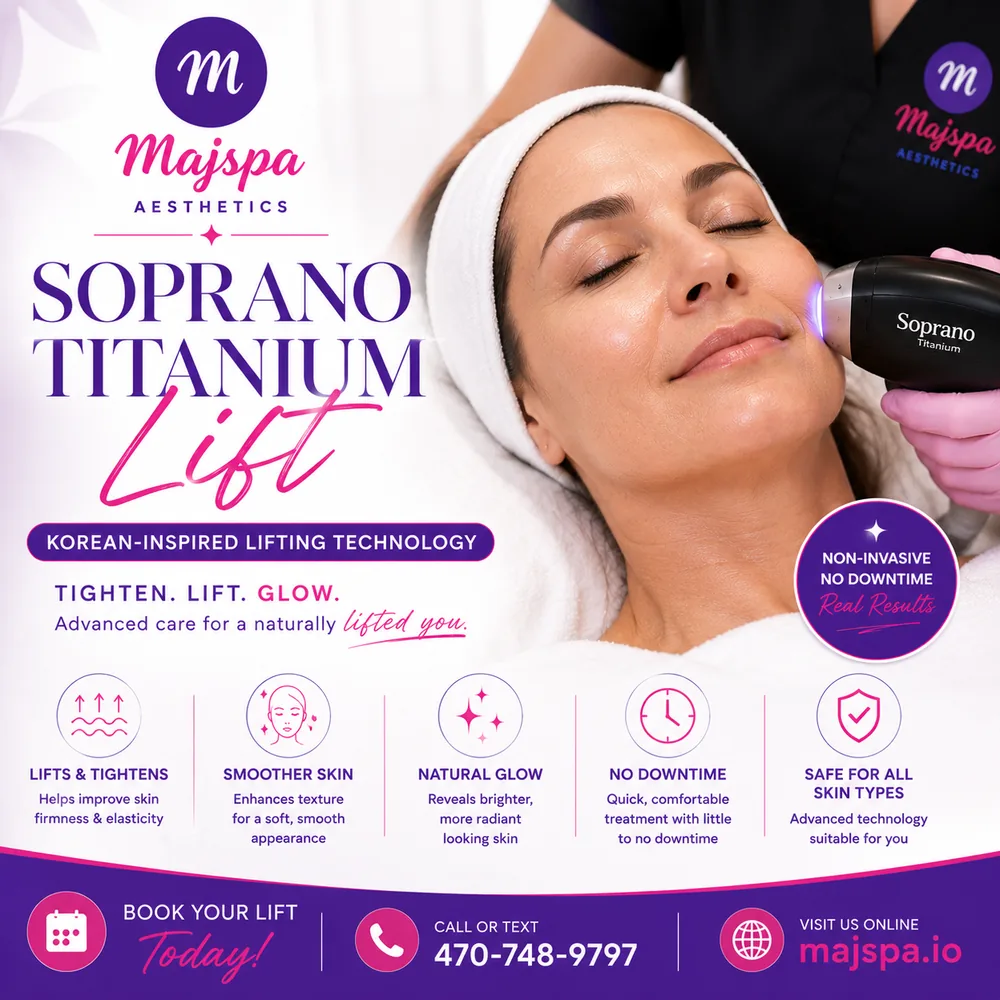
Majspa performs non-surgical laser lifting in Marietta, GA on the Alma Soprano Titanium — three wavelengths delivered at once to contract collagen and rebuild it, for lifting, brightening and contour. Treated areas are the face, neck, jawline and submental area under the chin. Sessions are 30 minutes with no downtime, priced at $299 or $720 for a course of three spaced 3–4 weeks apart. Safe for all Fitzpatrick skin types I–VI. For comparison, Ultherapy in the US typically runs $2,300–$2,600 for a single area.
Known overseas as titanium lifting or the BTS laser — brightening, tightening, slimming — this is the lifting protocol on the same platform we use for laser hair removal. It suits early laxity, a softening jawline and dullness. It is not a substitute for surgery, and this page says where that line falls.
Per session
$299
Course of 3
$720
Time
~30 minutes
Downtime
None
Skin types
All (I–VI)
Areas
Face, neck, jawline, submental
Most searches for a non-surgical facelift near me end at a page that will not name the device or the price. Here are both. The treatment runs on an Alma Soprano Titanium, which sits in our treatment room already — it is the platform behind our laser hair removal, and the lifting protocol uses the same three wavelengths in a different technique.
What the three wavelengths do
A single-wavelength laser reaches one depth. This platform fires three together, which is why the protocol is described abroad as BTS — brightening, tightening, slimming:
| Wavelength | Depth | What it contributes |
|---|---|---|
| 755 nm | Upper dermis | Tone and clarity — the brightening |
| 810 nm | Mid dermis | The bulk of the collagen response — the tightening |
| 1064 nm | Deep dermis | Deeper heating toward contour — the slimming |
The technique matters as much as the wavelengths. Instead of a handful of high-energy pulses, the handpiece sweeps continuously at low fluence with contact cooling running throughout, building heat gradually rather than shocking the tissue. That is what keeps it comfortable and downtime-free, and it is also why the result is cumulative rather than immediate.
Which areas we treat
Face, neck, jawline and the submental area — the soft tissue under the chin. Those four are usually treated together rather than in isolation, because laxity does not respect boundaries: tightening a jawline while leaving the neck untreated tends to draw attention to the contrast rather than hide it.
The submental area is worth calling out. It is the region people mean when they talk about a double chin or a soft jaw profile, and it is where the deeper 1064 nm wavelength does most of its work — the slimming in brightening, tightening, slimming. It is also the area most likely to need the full course rather than a trial session, because there is more tissue to influence.
What it will and will not do
The honest version, because this category is oversold. Laser lifting tightens the collagen you still have and prompts your body to make more. Expect firmer skin, a cleaner jawline, better tone and a rested look that builds over two to three months.
It will not remove excess skin, and it will not reproduce what a surgeon does. If you have significant sagging, a facelift is a different order of change and no laser will match it. If you are in your thirties, forties or fifties and noticing the first softening rather than true descent, this is the right category — and starting earlier gives the collagen response more to work with.
How this compares to what else is out there
The alternatives people weigh against this are Ultherapy, Thermage and PDO threads. They are genuinely different, and the honest summary is that each wins on something:
| Option | How it works | Downtime | Typical US cost |
|---|---|---|---|
| Soprano Titanium (here) | Triple-wavelength laser heat | None | $299, or $720 for three |
| Ultherapy | Focused ultrasound to the SMAS | Minimal | $2,300–$2,600 per area |
| Thermage | Monopolar radiofrequency | Minimal | Varies by provider |
| PDO threads | Threads placed to reposition tissue | 3–7 days, real | $1,500–$4,500 |
Two things are worth knowing before you book anything. PDO threads carry genuine downtime — swelling and restricted facial movement for several days — which is rarely the headline in the advertising. And Ultherapy delivers more lift in one session because focused ultrasound reaches the SMAS layer, deeper than a laser goes; if you want the largest non-surgical change in a single visit and the cost is acceptable, that is the fair answer. Our full comparison guide lays all four out properly.
How this differs from ClearLift
We run two laser treatments that both improve skin firmness, so the distinction matters. ClearLift is a Q-switched Nd:YAG firing ultra-short pulses that create a photoacoustic effect in the dermis — the stronger answer for fine lines, texture and surface rejuvenation. Soprano Titanium lifting builds bulk heat to contract collagen — aimed at laxity, jawline definition and contour.
Same price point, same 30 minutes, same absence of downtime. Different problems. Which one you want is genuinely a consultation question, and if the answer is a mix of both we will say so.
What a session is like
Skin is cleansed and a thin layer of gel is applied. The provider moves the handpiece over the treatment area in passes for roughly 30 minutes, checking temperature as they go. You feel building warmth with the cooling running against it. Afterwards there may be mild flushing for a few minutes up to a couple of hours; makeup and your normal skincare can go straight back on. Sunscreen the following days is not optional — new collagen deserves protecting.
Pricing
| Option | Price | Per session |
|---|---|---|
| Single session | $299 | $299 |
| Course of three (3–4 weeks apart) | $720 | $240 — saves $177 |
Most people take the course, because collagen change accumulates and a single session is better thought of as a trial than a treatment. CareCredit financing is accepted, and new clients receive a complimentary consultation where the plan and the number are agreed before anything begins.
Where we serve
Performed at our Marietta studio at 1401 Johnson Ferry Rd, serving clients across Cobb, Cherokee and Paulding counties and metro Atlanta — including Marietta, East Cobb, Kennesaw, Roswell, Sandy Springs, Smyrna, Vinings, Canton, Powder Springs, Austell, Dallas and Woodstock. Saturday appointments 9–3.
Frequently asked questions
What is Soprano Titanium lifting?
A laser skin-lifting treatment on the Alma Soprano Titanium, the same platform behind our laser hair removal. Three wavelengths — 755, 810 and 1064 nm — are delivered together while the handpiece sweeps the skin, building controlled heat in the dermis that contracts existing collagen and prompts new collagen over following weeks. Overseas it is marketed as titanium lifting or the BTS laser: brightening, tightening, slimming.
Which areas can be treated?
Face, neck, jawline and the submental area under the chin. These are usually treated together, since tightening a jawline while leaving the neck alone tends to highlight the contrast rather than hide it. The submental area — what most people mean by a double chin or soft jaw profile — is where the deeper 1064 nm wavelength does most of its work, and the area most likely to need the full course rather than a single trial session.
Is a non-surgical facelift the same as a surgical facelift?
No, and we would rather say so plainly. Surgery removes and repositions tissue, producing a far larger change lasting years. Laser lifting tightens the collagen you still have and encourages more. With significant sagging or excess skin, a surgeon gives a result this cannot match. With early laxity, a softening jawline or dullness — and no appetite for downtime — this is the category that fits.
How much does a non-surgical facelift cost in Marietta?
$299 per session, or $720 for a course of three — $240 a session, saving $177. Most people take the course. For context, Ultherapy in the US typically runs $2,300–$2,600 for one area. CareCredit financing is available.
How many sessions, and how far apart?
A course of four, spaced 3–4 weeks apart, is the standard plan, each about 30 minutes. Collagen remodels slowly, so peak visible change lands 2–3 months after the final session rather than on the day.
Does it hurt, and is there downtime?
No downtime. Low energy delivered in motion with the handpiece cooling continuously means most people report a spreading warmth rather than anything sharp. Mild flushing can last a few minutes to a couple of hours. Makeup and normal skincare go back on the same day.
Is it safe for darker skin tones?
Yes. The platform is built around the 1064 nm wavelength, barely absorbed by surface melanin, and is used here across Fitzpatrick I through VI — the same reason it is safe for hair removal on darker skin where older alexandrite-only systems were not.
How is this different from ClearLift?
Different principles, different complaints. ClearLift is Q-switched Nd:YAG firing ultra-short pulses for a photoacoustic effect — better for fine lines, texture and surface rejuvenation. Soprano Titanium builds bulk heat to contract collagen — aimed at laxity, jawline definition and contour. Some clients alternate them; that is a consultation decision, not a web-page one.
Can it be combined with Botox or fillers?
Yes, and they do different jobs. Botox relaxes the muscles behind expression lines, fillers restore lost volume, and laser lifting works on the quality and tension of the skin itself. Sequencing matters for comfort and safety, so tell us what else you are having and we will plan the visit around it.
Book your non-surgical facelift consult
Complimentary for new clients. We will tell you honestly whether this is the right category for your skin — including when it is not. Saturday appointments are available, 9–3.